Micro:bit
This chapter is the Start Point in the journey to build and explore Micro:bit and Micro:Rover electronic projects.
Meet micro:bit
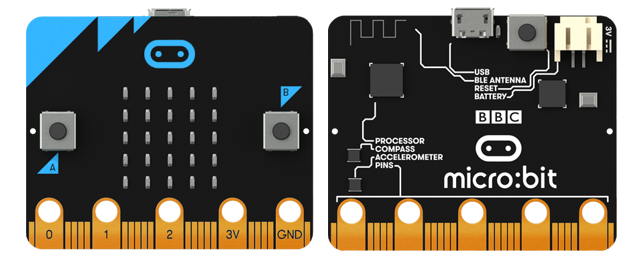
The BBC micro:bit is a pocket-size, programmable micro-computer that can be used for all sorts of cool creations, from robots to musical instruments – the possibilities are infinite.
For more contents, please refer to:
Features
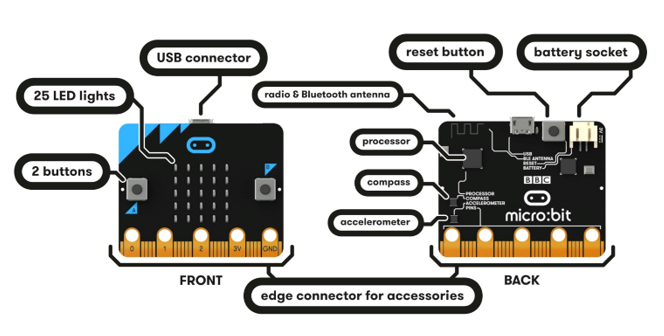
Your micro:bit has the following physical features:
25 individual programmable LEDs
2 programmable buttons
Physical connection pins
Light and temperature sensors
Motion sensors (accelerometer and compass)
Wireless Communication, via Radio and Bluetooth
USB interface
For more details, please refer to:
Hardware
It is not required for beginners to master this section, but a brief understanding is necessary. However, if you want to be a developer, hardware information will be very helpful. Detailed hardware information about micro:bit can be found here: https://tech.microbit.org/hardware/.
First, get to know the micro:bit GPIO.
GPIO
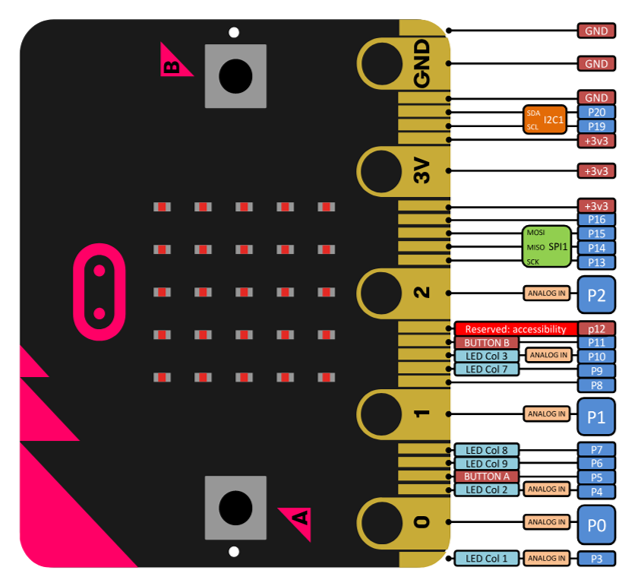
GPIO, namely General Purpose Input/output Pins, is an important part of micro:bit for connecting external devices. All sensors and devices on Rover communicate with each other through micro:bit GPIO. The following is the GPIO serial number and function diagram of micro:bit: