40. Chapter Control LED with Web (WiFi Board)
In this chapter, we will use control board to make a simple smart home. We will learn how to control LED lights through web pages.
40.1. Project Control the LED with Web
In this project, we need to build a Web Service and then use the control board to control the LED through the Web browser of the phone or PC. Through this example, you can remotely control the appliances in your home to achieve smart home.
40.1.1. Component List
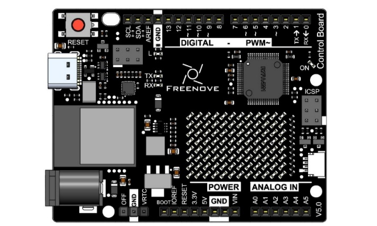
Control board x1 |
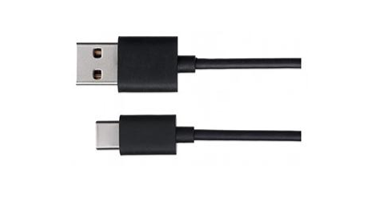
USB cable x1 |
|
|
40.1.2. Component knowledge
40.1.2.1. HTML
HyperText Markup Language (HTML) is a standard Markup Language for creating web pages.It includes a set of tags that unify documents on the network and connect disparate Internet resources into a logical whole.HTML text is descriptive text composed of HTML commands that describe text, graphics, animations, sounds, tables, links, etc.The extension of the HTML file is HTM or HTML.Hyper Text is a way to organize information.It uses hyperlinks to associate words and charts in Text with other information media.These related information media may be in the same Text, other files, or files located on a remote computer.This way of organizing information connects the information resources distributed in different places, which is convenient for people to search and retrieve information.
The nature of the Web is hypertext Markup Language (HTML), which can be combined with other Web technologies (e.g., scripting languages, common gateway interfaces, components, etc.) to create powerful Web pages. Thus, HYPERtext Markup Language (HTML) is the foundation of World Wide Web (Web) programming, that is, the World Wide Web is based on hypertext. Hypertext Markup Language is called hypertext Markup language because the text contains so-called “hyperlink” points.
You can build your own WEB site using HTML, which runs on the browser and is parsed by the browser.
Example analysis is shown in the figure below:
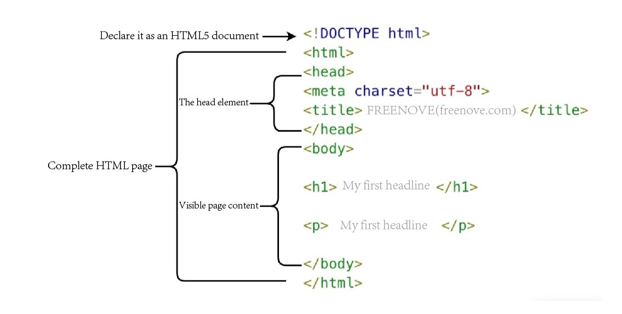
<!DOCTYPE html>: Declare it as an HTML5 document
<html>: Is the root element of an HTML page
<head>: Contains meta data for the document, such as < meta charset=”utf-8”> Define the web page encoding format to UTF-8.
<title>: Notesthe title of the document
<body>: Contains visible page content
<h1>: Define a big heading
<p>: Define a paragraph
For more information, please visit: https://developer.mozilla.org/en-US/docs/Web/HTML
40.1.3. Circuit
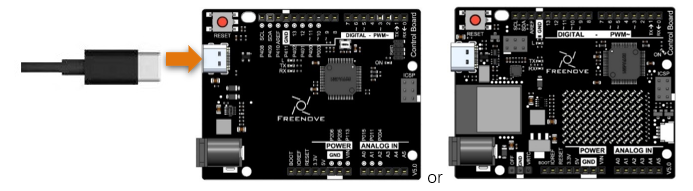
Connect the board to the computer using the USB cable.
40.1.4. Sketch
40.1.4.1. Sketch_40.1.1
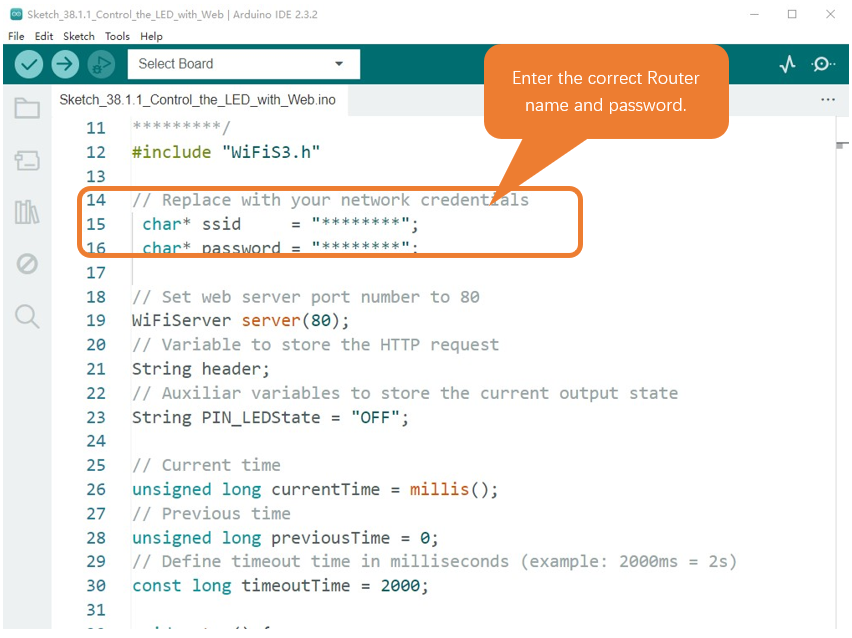
Upload the code to the control board, open the serial monitor and set the board rate to 115200. After the board connects to WiFi successfully, the IP address will be printed out, as shown below.
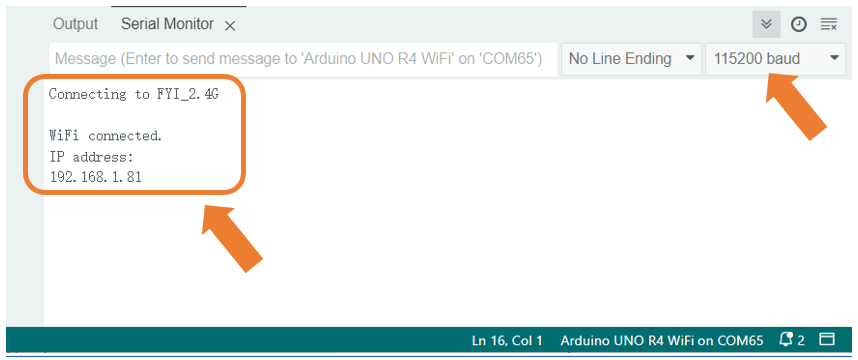
When Control Board successfully connects to “ssid_Router”, serial monitor will print out the IP address assigned to Control Board by the router. Access http://192.168.1.26 in a computer browser on the LAN. As shown in the following figure:
You can click the corresponding button to control the LED on and off.
The following is the program code:
  1/**********************************************************************
  2  Filename    : Sketch_40.1.1_Control_the_LED_with_Web
  3  Description : Control the LED with Web
  4  Auther      : www.freenove.com
  5  Modification: 2024/08/05
  6**********************************************************************/
  7
  8#include "WiFiS3.h"
  9
 10// Replace with your network credentials
 11 char* ssid     = "********";
 12 char* password = "********";
 13
 14// Set web server port number to 80
 15WiFiServer server(80);
 16// Variable to store the HTTP request
 17String header;
 18// Auxiliar variables to store the current output state
 19String PIN_LEDState = "OFF";
 20
 21// Current time
 22unsigned long currentTime = millis();
 23// Previous time
 24unsigned long previousTime = 0;
 25// Define timeout time in milliseconds (example: 2000ms = 2s)
 26const long timeoutTime = 2000;
 27
 28void setup() {
 29  Serial.begin(115200);
 30  // Initialize the output variables as outputs
 31  pinMode(LED_BUILTIN, OUTPUT);
 32  digitalWrite(LED_BUILTIN, LOW);
 33
 34  // Connect to Wi-Fi network with SSID and password
 35  Serial.print("Connecting to ");
 36  Serial.println(ssid);
 37  WiFi.begin(ssid, password);
 38  while (WiFi.status() != WL_CONNECTED) {
 39    delay(500);
 40    Serial.print(".");
 41  }
 42  // Print local IP address and start web server
 43  Serial.println("");
 44  Serial.println("WiFi connected.");
 45  Serial.println("IP address: ");
 46  Serial.println(WiFi.localIP());
 47  server.begin();
 48}
 49void loop() {
 50  WiFiClient client = server.available();  // Listen for incoming clients
 51  if (client) {                            // If a new client connects,
 52    Serial.println("New Client.");         // print a message out in the serial port
 53    String currentLine = "";               // make a String to hold incoming data from the client
 54    currentTime = millis();
 55    previousTime = currentTime;
 56    while (client.connected() && currentTime - previousTime <= timeoutTime) {  // loop while the client's connected
 57      currentTime = millis();
 58      if (client.available()) {  // if there's bytes to read from the client,
 59        char c = client.read();  // read a byte, then
 60        Serial.write(c);         // print it out the serial monitor
 61        header += c;
 62        if (c == '\n') {  // if the byte is a newline character
 63          // if the current line is blank, you got two newline characters in a row.
 64          // that's the end of the client HTTP request, so send a response:
 65          if (currentLine.length() == 0) {
 66            // HTTP headers always start with a response code (e.g. HTTP/1.1 200 OK)
 67            // and a content-type so the client knows what's coming, then a blank line:
 68            client.println("HTTP/1.1 200 OK");
 69            client.println("Content-type:text/html");
 70            client.println("Connection: close");
 71            client.println();
 72            // turns the GPIOs on and off
 73            if (header.indexOf("GET /LED_BUILTIN/ON") >= 0) {
 74              Serial.println("LED_BUILTIN ON");
 75              PIN_LEDState = "ON";
 76              digitalWrite(LED_BUILTIN, HIGH);
 77            } else if (header.indexOf("GET /LED_BUILTIN/OFF") >= 0) {
 78              Serial.println("LED_BUILTIN OFF");
 79              PIN_LEDState = "OFF";
 80              digitalWrite(LED_BUILTIN, LOW);
 81            }
 82            // Display the HTML web page
 83            client.println("<!DOCTYPE html><html>");
 84            client.println("<head> <title>Control Board Web Server</title> <meta name=\"viewport\" content=\"width=device-width, initial-scale=1\">");
 85            client.println("<link rel=\"icon\" href=\"data:,\">");
 86            // CSS to style the on/off buttons
 87            // Feel free to change the background-color and font-size attributes to fit your preferences
 88            client.println("<style>html {font-family: Helvetica; display:inline-block; margin: 0px auto; text-align: center;}");
 89            client.println(" h1{color: #0F3376; padding: 2vh;} p{font-size: 1.5rem;}");
 90            client.println(".button{background-color: #4286f4; display: inline-block; border: none; border-radius: 4px; color: white; padding: 16px 40px;text-decoration: none; font-size: 30px; margin: 2px; cursor: pointer;}");
 91            client.println(".button2{background-color: #4286f4;display: inline-block; border: none; border-radius: 4px; color: white; padding: 16px 40px;text-decoration: none; font-size: 30px; margin: 2px; cursor: pointer;}</style></head>");
 92            // Web Page Heading
 93            client.println("<body><h1>Control Board Web Server</h1>");
 94            client.println("<p>GPIO state: " + PIN_LEDState + "</p>");
 95            client.println("<p><a href=\"/LED_BUILTIN/ON\"><button class=\"button button2\">ON</button></a></p>");
 96            client.println("<p><a href=\"/LED_BUILTIN/OFF\"><button class=\"button button2\">OFF</button></a></p>");
 97            client.println("</body></html>");
 98            // The HTTP response ends with another blank line
 99            client.println();
100            // Break out of the while loop
101            break;
102          } else {  // if you got a newline, then clear currentLine
103            currentLine = "";
104          }
105        } else if (c != '\r') {  // if you got anything else but a carriage return character,
106          currentLine += c;      // add it to the end of the currentLine
107        }
108      }
109    }
110    // Clear the header variable
111    header = "";
112    // Close the connection
113    client.stop();
114    Serial.println("Client disconnected.");
115    Serial.println("");
116  }
117}
Include the WiFi Library header file of Control Board.
1#include "WiFiS3.h"
Enter correct router name and password.
1// Replace with your network credentials
2 char* ssid     = "********";
3 char* password = "********";
Set Control Board in Station mode and connect it to your router.
1WiFi.begin(ssid, password);
Check whether Control Board has connected to router successfully every 0.5s.
1while (WiFi.status() != WL_CONNECTED) {
2  delay(500);
3  Serial.print(".");
4}
Serial monitor prints out the IP address assigned to Control Board.
1Serial.println(WiFi.localIP());
Click the button on the web page to control the LED light on and off.
 1// turns the GPIOs on and off
 2if (header.indexOf("GET /LED_BUILTIN/ON") >= 0) {
 3  Serial.println("LED_BUILTIN ON");
 4  PIN_LEDState = "ON";
 5  digitalWrite(LED_BUILTIN, HIGH);
 6} else if (header.indexOf("GET /LED_BUILTIN/OFF") >= 0) {
 7  Serial.println("LED_BUILTIN OFF");
 8  PIN_LEDState = "OFF";
 9  digitalWrite(LED_BUILTIN, LOW);
10}